Hiển thị các bài đăng có nhãn facebook. Hiển thị tất cả bài đăng

Thứ Sáu, 14 tháng 12, 2012

Busted on Social Media - Police Video

facebook, youtube, social media, crime, busted, criminal defense, criminal defense attorney, witnesses
Busted on Social Media
Gang busted on Social Media. According to police: The gangs were taunting on Facebook, bragging about shootings online. The gangs allegedly used social media to intimidate witnesses and others, calling them snitches and stating that if they cooperated with law enforcement  they would be "taken care of." Possible 25 year penalties for the 25 that were busted using social media. Social media led to their demise, as cops monitored and befriended the suspects.


Thứ Sáu, 14 tháng 9, 2012

Judge Gayles Just "Unfriended" Me!

 
Was anyone practicing when "faxes" came along?

I remember lengthy discussions, ethics opinions, and substantial research devoted to what the appropriate disclaimer a law firm should place along the bottom half of the fax cover sheet.

This was the result of uncertainty over how documents that used to be mailed can be magically transported through telephone lines to be reassembled at the other end by bulky, loud perforated-sheet fax monstrosities.  What if an important document is sent to the wrong number?

Same with email -- are they privileged if faceless "servers" have access to your content while assembling and reassembling data packet transmissions to your client?  How detailed should my disclaimer be?

We face that same fear of technology in this 4th DCA opinion regarding being "Facebook friends" with a presiding judge:
Further, the Committee concluded that when a judge lists a lawyer who appears before him as a “friend” on his social networking page this “reasonably conveys to others the impression that these lawyer ‘friends’ are in a special position to influence the judge.”

That's right -- for example, I'm "friends" with both President Obama and Tim Gunn so I can reasonably expect these guys to do me a solid from time to time.

I don't necessarily blame the 4th here -- they were working off of a 2009 ethics advisory opinion and felt constrained to adopt that reasoning.

2009?

In interweb years that is ancient history -- it's like three Friendsters ago!

Thứ Tư, 6 tháng 10, 2010

Criminal Defense and Social Media

Tampa Criminal Defense
Tampa Criminal Defense Attorney saw reports of a news article in the National Law Journal (NLJ) suggesting that people use information about clients on Facebook and MySpace as mitigating evidence. One Federal Defense Attorney suggested, "We should be asking every client if they have a social network account, and if so, to cease and desist using it immediately."

The defense attorney also suggested, "It is also a good idea, if they have one of these accounts, to get access to it, just as you would get school, psych and medical records. You may learn something about the client that he didn't tell you, which could give a good lead for other mitigation, or alert you to potentially damaging info that you may need to address."

Finally an experienced federal defense attorney noted, "The [NLJ] article's suggestion that defendants use Facebook as a "sentencing advocacy tool" by contacting all of their "friends" seems nothing short of reckless." The attorney continued, "[T]here is arguably little value to the positive comments posted by 1000 friends who don't really know the client either, and probably have gotten their facts from the client. Having a client post anything about his or her case anywhere is ill-advised as that information could be used against the client by the probation office or prosecutors if a friend provides it to them."

I agree with our source.

Thứ Sáu, 1 tháng 10, 2010

Criminal Defense Attorney | Feds on Facebook | Social Networking and Law Enforcement Tactics

W.F. "Casey" Ebsary, Jr.
Tampa Criminal Defense Expert, W.F. ''Casey'' Ebsary, Jr., has suspected that cops use "fake identities" to "trick" users into accepting a government official as friend or otherwise provide information to the government. We believed that the feds watch Facebook, MySpace, Twitter, Flickr and other online social media and use the information for investigative (criminal or otherwise) or data gathering purposes.

A recent public records request by the EFF sought more information including:

Guides, manuals, policy statements, memoranda, presentations, or other materials explaining how government agents should collect information on social networking websites: how or when government agents may collect information through social networking websites; procedures government agents must follow to collect information through social networking websites; agreements with social-networking companies: using any visualization programs, data analysis programs or tools used to analyze data gathered from social networks; purchase orders for any visualization programs,data analysis programs or tools used to analyze data gathered from social networks; describing how information collected from social-networking websites is retained in government databases or shared with other government agencies.

How to be a Fed on Facebook
18 U.S.C. § 2702, Computer Crime and Intellectual Property Section, ECPA, EFF, Electronic Communications Privacy Act, Facebook, LinkedIn, Twitter, Yahoo
Prosecutor's Obtaining Evidence From Social Networks
Training Materials
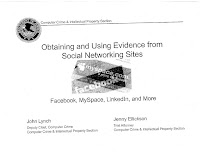
The feds produced a 33 page record. We just took a look at it and it appears to be a training program. The document was titled, "Obtaining and Using Evidence Social Networking Sites from Facebook, MySpace, Linkedin, and More." It was authored by John Lynch, Deputy Chief, Computer Crime and Jenny Ellickson, Trial Attorney of the  Computer Crime and Intellectual Property Section.

The outline covered an Introduction to Social Networking Sites and an Overview of Key Social Networking Sites. Not suprisingly, buried in the training materials is the question: Why go undercover on Facebook, MySpace, etc? The answer in short succinct bullet points was to "Communicate with suspects / targets" and "Gain access to non-public info" and to "Map social relationships/networks." The training session begins:  "Most social-networking sites allow users to:

•    Create personal profiles
•    Write status updates or blog entries
•    Post photographs, videos, and audio clips
•    Send and receive private messages
•    Link to the pages of others (i.e., “friends”)"

How can Law Enforcement Obtain data from these sites?

•    Some info may be public
•    Use ECPA to get info from providers
•    Undercover operations "

The ECPA is the Electronic Communications Privacy Act (ECPA) and it sets out the provisions for access, use, disclosure, interception and privacy protections of electronic communications. The feds use this information to:

•  Reveal personal communications
•  Establish motives and personal relationships
•  Provide location information
•  Prove and disprove alibis
•  Establish crime or criminal enterprise

How do the Feds get information from Facebook?

Since the Facebook Data is organized by user ID or group ID they use these resources: Data productions using the Fed's Law Enforcement Guide includes Neoprint, Photoprint, User Contact Info, Group Contact Info, and IP Logs. The feds noted that "Facebook has other data available." and that Facebook is "Often cooperative with emergency requests." That means that the feds can claim urgency and shourtcut the time frames that are usually present when legal production of this information is sought.

What do the Feds Think about MySpace?

The feds noted that MySpace is owned by Fox Interactive Media and was the most popular Social Network; was passed by Facebook in 2008; True names are less encouraged than Facebook. Feds are noting there is Messaging through messages, chat, friend updates. MySpace has a Young user base,has a history of child safety concerns, and Privacy is currently less granular than Facebook. Cybercrime defense attorney notes that Granular Privacy Controls in social networks allow authorization profiles - the user gets to decide what data to show to other friends in the network. 

How do the Feds Get Info From MySpace?

The Feds know that many profiles have public content and thatData is organized by Friend ID. Notably, MySpace requires a search warrant for private messages or bulletins that are less than 181 days old. MySpace considers friend lists to be stored content and there are fixed Data retention times for User information and stored files. MySpace retains IP logs indefinitely and information for deleted accounts is kept for a year.

What the Feds believe about Twitter?

Twitter is the market leader in “micro-blogging.” Most Twitter multimedia is handled by 3d party links. Twitter allows both public or private updates. On Twitter Direct messages are private and the sender can delete these messages. the feds noted that short URLs used to serve malicious links and code.

How do the Feds Get Information from Twitter?

The good news for the Feds is that Most Twitter content is public and Private messages are kept until the user deletes them.

The bad news for the Feds is that Twitter only retains the first login IP, there is no user contact phone number, Twitter Will not preserve data without legal process, and Twitter has a stated policy of producing data only in response to legal process.

The Feds frequently use a 2702 request to short cut Search Warrant requirements. On the other hand, as of 2010, Yahoo has the following policy on 2702 requests from cybercrime investigators:

"Under 18 U.S.C. §§ 2702(b)(7) and 2702(c)(4) Yahoo! is permitted, but not required, to voluntarily disclose information, including contents of communications and customer records, to a federal, state, or local governmentalentity if Yahoo! believes in good faith that an emergency involving imminent danger of death or serious physical injury to any person requires such disclosure without delay."

What about LinkedIn?

The feds use LinkedIn to identify experts and check the background of defense experts. The Privacy model is similar to Facebook and Profile information is not checked for reliability.

Federated Identity Issues Concern the Feds

The Feds note an upsurge in federated identity schemes. Social networking sites are increasingly adopting federated identity schemes such as OpenID, Facebook Connect. They write of concerns that Facebook, MySpace, Yahoo!, and Google authenticate identity and signin across platforms.

They give the following Example: A user can log in to a Facebook account using Google credentials. After a link is established between two accounts, Google will check and vouch for identity of its user. Authentication information split from activity information. In turn, a Facebook login may be used to authenticate.

The feds note that "If attribution is necessary, must determine identity provider - not simply the domain."

Terms of Service TOS and Privacy Policies

The Federal Agent Training materials we reviewed after the EFF Freedom of Information Act FOIA Request noted that Social networks have extensive terms of service and privacy policies, most permit emergency disclosures to Law Enforcement. All specify exceptions to respond to legal process and protect service against fraud/damage

U.S. v. Drew addressed the failure to follow TOS and whether access to a network was unauthorized under 1030? Drew addresses whether allowing a violation of a website's Terms of Service to constitute an intentional access of a computer without authorization or exceeding authorization would "result in transforming section 1030(a)(2)(C) into an overwhelmingly overbroad enactment that would convert a multitude of otherwise innocent Internet users into misdemeanant criminals."

Criminal Penalties for Law Enforcement Officers for Violating the Privacy Protection Act

The feds also are concerned about the growth of social networks and the questions it raises about the breadth of the PPA. This author notes that the Privacy Protection Act provides for criminal penalties against federal officials who willfully disclose a record in violation of the Act, 5 U.S.C. § 552a(i)(1).

Thứ Ba, 18 tháng 5, 2010

Relax, Facebook Just Wants to "Harvest" Your Data!


But first they want to tenderize it some, like those friendly farmers from Motel Hell:

Alana Joy, who started the Facebookprotest.com site organizing the June 6 event, said she is more upset about the way Facebook has made changes, rather than what's changed.

``Just because you post something online doesn't mean it's for the whole wide world to see,'' said Joy, a Los Angeles-based marketing strategist who doesn't use her full legal name online or professionally because of privacy issues.

Her biggest gripe?

``They also didn't explain them in changes that my 18-year-old sister and my grandmother can understand,'' Joy said.

Lior Leser, an Internet lawyer who actually writes similar privacy policies, agreed with Joy.

``The problem is they never really present what's happening,'' said Leser, who is with the Miami Beach firm Leser Hunter Taubman Taubman. ``How about, `Hey, we're a free service, but this is how we use your information to sell ads -- that's how we make money.' ''

I printed out Facebook's privacy policy: it's five, single-space pages of type that's at least half the size of these newspaper characters.


Finally, to Internet lawyer Lior Leser -- I had no idea such a practice area exists btw -- will you be my friend?

Thứ Năm, 4 tháng 3, 2010

It's Nice to Have Friends


You gotta love how they do things in Broward:
As she presided over a first-degree murder case, Broward Circuit Court Judge Ana Gardiner engaged in a close and inappropriate personal relationship with the prosecutor, a state judicial watchdog agency claimed in charges filed Wednesday.

Because of the allegations against Gardiner, the defendant in the case, who had been sentenced to death, has been granted a new trial.

From March 23 through August 24, 2007, Gardiner and then prosecutor Howard Scheinberg had 949 telephone calls and exchanged 471 text messages, according to the complaint filed by the Judicial Qualifications Commission.

Gardiner, 48, is also accused of improperly discussing and joking with Scheinberg about the case at Timpano's, an upscale Fort Lauderdale restaurant, four days before a Broward County jury returned a guilty verdict.

JAAB has tons of additional links here.

Yawn.

Sure it's a scandal and all, but the real question that needs to be answered immediately is this: were they friends on Facebook?

(Note to Dade County Bar -- you need a better way to link to your articles.)

Thứ Sáu, 11 tháng 12, 2009

Why Can't We Be Friends?


This was exactly what I was going to say, but as usual Markus beat me to it:
“This seems out of proportion to what really is occurring. I suspect the rules are being made by people who don’t understand the computer era.”
The notion that being a "friend" to someone on Facebook could, in the words of the committee, "convey the impression that they are in a special position to influence the judge" is just utter asshattery.

Let me give you an example.

I'm pretty sure all lawyers, living or dead, are "friends" with ubiquitous Facebooker David Barrett.

I have no idea who David is, but given his endless stream of useless and pointless promotional activity, if I ever do meet him I plan to punch him square in the face.

See how that works, honorable Bar committee?

It's a classic example of (1) coming too late to a perceived problem; (2) not understanding the fluid dynamics of a new technology; (3) using an old paradigm to address a perceived problem that has already transformed itself in a way that resolves the problem you thought you were addressing; and (4) "fixing" the now-outdated perceived problem in the entirely wrong way.

It reminds me of how they burned Beatles records because John said they were bigger than Jesus Christ.

You just don't get it, do you?

Thứ Sáu, 30 tháng 10, 2009

There Was Another Lawyer Who "Attended" Obama's Fundraiser


You remember how a bunch of South Florida lawyers got together with former law professor President Obama on Miami Beach a few days ago?

Well there was another lawyer there who I forgot to mention, except he was outside demonstrating against the President's visit:
Although the president brought good news to Florida, not every one here welcomed his visit. About 100 people – many of them protestors – assembled outside the Fontainebleau Hotel in Miami Beach, where the president spoke at the Tuesday evening fundraiser.

"Obama Sucks," read a sign held by a man on the corner of Collins Avenue.

Jose Llerena, 41, a Miami lawyer, was among the largely Cuban, anti-Obama crowd.

“He is one of the most divisive presidents we've had,” Llerena said. “I want this president to know that we don't like him. He doesn't believe in us. I hope he realizes that the Democratic Party is going to have a significant loss in 2010."
I don't know much about Jose, other than he is a labor lawyer who works for Jorge L. Fors and who once worked at George Hartz in the Gables.

He also has a jamming website.

et al et cetera et cetera et al -- interesting marketing strategy.

Also, according to his public Facebook page, Jose shares this message:
Banded together from remote galaxies are 13 of the most sinister villains of all time: The Legion of Dems. Dedicated to a single objective: the Marxist conquest of the US.Only 1 group dares to challenge this intergalactic threat: The Founding Fathers
I'm going to assume (hope?) this is a tongue-in-cheek Star Wars/BG-type parody.

If so, it still needs a little work, but could be a great comic book.

Also Jose doesn't like czars, wants Fidel to die, and is a big fan of Alex Foley.

Really, though, who isn't?

Bài đăng phổ biến